Cleaning does not always mean disinfecting: what your home really needs
The kitchen can look spotless: a shiny countertop, a sink without a single drop, and that fresh floral scent from your favorite detergent that makes you think everything has been taken care of. However, appearance tells only part of the story. Some surfaces can look perfectly clean and still harbor microorganisms that we cannot see because they are microscopic.
Do you remember when we started paying attention again to something as basic as washing our hands properly? Back around 2019… The big lesson was understanding that quickly rubbing on a little soap is not enough: technique, time, and the right product matter. The same is true when caring for our homes.
The real difference between cleaning and disinfecting is knowing what each space needs, when it needs it, and why. That principle also guides our professional cleaning services in Tampa Bay: first, we remove dust, grease, and debris; then, we use disinfecting products on the surfaces and in the situations where they truly add value. Baywatcher Cleaning offers residential and commercial services with HEPA-filter vacuums and special attention to high-touch surfaces. Baywatcher Cleaning always watching, truly clean!
Cleaning, sanitizing, and disinfecting do not mean the same thing
Oh noo!! We do not need to turn the house into a laboratory or chase every microbe with a spray bottle! We need to clean with knowledge, use fewer unnecessary products, and achieve better results.
Although these terms often appear together on labels and advertisements, they describe different processes.
Cleaning removes dirt and some microorganisms.
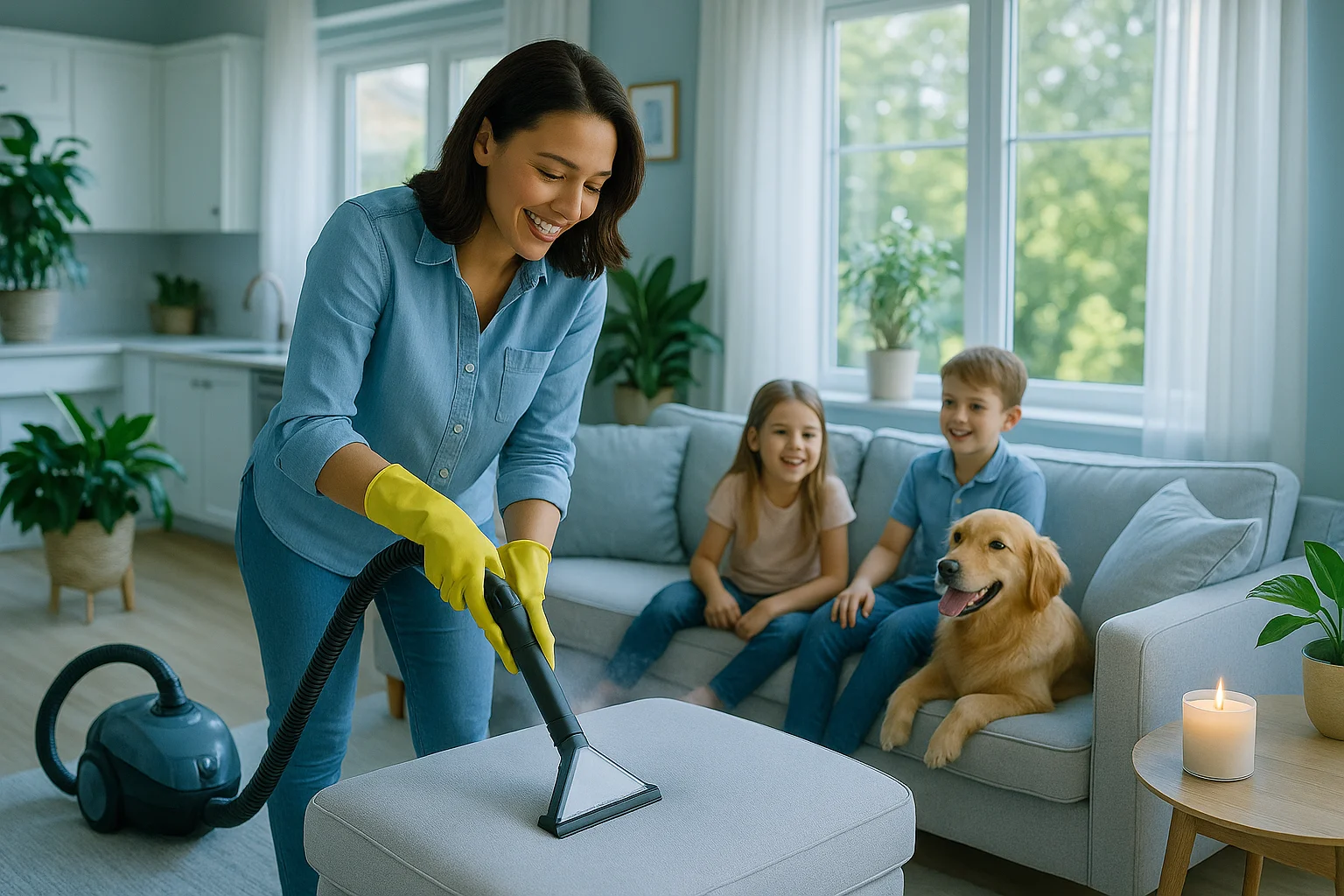
Cleaning means using water, soap, detergent, or a compatible product to remove dust, grease, and debris through physical action: vacuuming, scrubbing, and wiping with a clean cloth.
The CDC guide for cleaning and disinfecting your home explains that regularly cleaning with soap or detergent removes most harmful germs found on many household surfaces. It also recommends cleaning before sanitizing or disinfecting because dirt can make it harder for the product to properly reach microorganisms. In Baywatcher Cleaning we use disinfecting cleaners, because we care health and wealth.
To put it in more everyday terms: disinfecting over grease, dust, or dried food is like applying perfume without taking a shower. It may smell convincing for a while, but the important work was left undone.
Allergens such as dust, pollen, and pet dander also do not disappear simply by spraying a disinfectant. They must be removed through vacuuming, washing, and physical cleaning.
Sanitizing reduces the number of germs, Did you know that?
Sanitizing is a step that comes after cleaning. Its purpose is to reduce the number of certain microorganisms to the levels specified on the product label.
It can be used on certain food-contact surfaces, some children’s items, and shared areas. Not all sanitizers are formulated to act against the same agents, so we should always check the label.
Disinfecting acts against specific microorganisms, usually more common.
Disinfecting means using a product formulated to kill or inactivate certain microorganisms that remain on a surface after it has been cleaned.
The word “certain” is important. No disinfectant should be assumed to be effective against absolutely everything. The label indicates which microorganisms it was tested against, where it can be used, and how long the surface must remain wet.
A healthy home does not need to be sterile, but with a low profile of microorganisms.
A door handle can look shiny and still be a high-touch surface. A phone can look clean after traveling from the kitchen to the car, from the purse to the desk, and finally to the bed.
But “microscopic” does not automatically mean constant danger. A healthy home needs a reasonable routine that combines cleaning, washing textiles, controlling dust, hand hygiene, and selective disinfection.
The goal is not to eliminate every microorganism on the planet—a mission that is far too ambitious for a Tuesday afternoon—but to intelligently interrupt the most common routes of contamination.
When is regular cleaning usually enough?
When no one is sick, or when you have an appointment with your esthetician in the next 15 minutes, while you look for a better excuse, grab an antimicrobial detergent and disinfect:
High-touch surfaces.
Faucet handles.
tables
Cabinet exteriors.
Counters tops and sinks.
Furniture.
floors
Our residential cleaning services in Tampa begin by removing dust, debris, and grease, including areas that are often left out of the routine, such as baseboards, window tracks, ceiling fans, doors, and the exterior grilles of vents. Baywatcher Cleaning’s residential page explains the differences between standard and deep cleaning. every home should go for the deep cleaning at least every 3 months, this frequency keep your home in good shape for maintenance cleanings regularly in between deepest ones!
Cleaning consistently also reduces the need to continually rely on stronger products. When maintenance is performed correctly, dirt does not have time to turn into a historic collection of layers and then develop into rhinitis, asthma or who knows what!
When should you disinfect more frequently?
There is a sick person in the home.
Someone who was sick recently visited.
A particularly vulnerable person lives in the home, such as an elderly person, a newborn, or someone who is immunocompromised.
A surface came into contact with bodily fluids, such as blood, saliva, mucus, and so on. (run your imagination)
Bathrooms, phones, or TV remotes are shared during an illness.
A surface came into contact with raw food. Watch your salads carefully!
Many people touched the same door handles, faucets, or light switches.
When a family needs more specific attention, residential cleaning with surface disinfection makes it possible to focus on priority areas without applying chemicals indiscriminately throughout the entire home.
The correct order changes the result
- Remove objects and visible debris
Move small appliances, containers, and decorations. Dispose of crumbs and debris so you can reach the entire surface.
When the work includes the inside of the refrigerator, oven, cabinets, or windows, premium cleaning options allow you to add these details to a regular or deep cleaning.
- Clean with a compatible product
Use soap, detergent, or a cleaner appropriate for the material. Not all natural stone, wood, fabric, or metal surfaces tolerate the same chemicals.
Read the label and test any new product on an inconspicuous area when appropriate.
- Select an EPA-registered disinfectant
The EPA information on registered disinfectants allows you to verify the uses and microorganisms for which each product was evaluated.
“EPA-registered” does not mean that it can be used in any manner. Its effectiveness and safety depend on following the label instructions exactly.
- Respect the contact time
Contact time is the period during which the surface must remain visibly wet. Spraying and immediately wiping may leave the countertop shiny, but not necessarily disinfected.
Pro tip: Read the entire “Directions for Use” section before you begin, while your hands are still dry, not when you already have the spray in one hand, the cloth in the other, and a slight crisis while staring at the fine print.
- Allow it to dry or rinse when appropriate
Some products must air-dry. Others require rinsing, especially on surfaces that will come into contact with food.
The label always has the final word.
Mistakes that can reduce effectiveness
Disinfecting a surface that is still dirty.
Mixing bleach with ammonia, vinegar, or other products.
Using the same cloth in the bathroom and the kitchen.
Mistaking a strong scent for greater effectiveness.
Ignoring the contact time.
Spraying electronic equipment directly.
Leaving products within reach of children or pets.
The CDC recommendations for using bleach safely warn that it should never be mixed with other cleaners because certain combinations can release dangerous fumes. They also recommend maintaining proper ventilation and following the label instructions.
A completely clean cloth matters
A slightly used cloth can transfer grease and debris from one area to another. For glass, mirrors, countertops, and freshly disinfected surfaces, use a completely clean cloth assigned to only one area.
You can organize them by color:
Blue for glass.
Gray for dust and furniture.
Another color for the kitchen.
A separate color for bathrooms.
Wash them with detergent and dry them completely. A detailed cleaning loses some of its charm when the cloth starts smelling as though it has made questionable decisions. You will find more practical advice on our cleaning and wellness blog for Tampa Bay homes, where we share articles for homes, offices, and healthy spaces and In Baywatcher Cleaning you can book your next cleaning and fell in love with our service and results.
Tampa’s humidity changes some priorities
In Tampa Bay, we should pay attention to bathrooms, laundry rooms, areas around windows, spaces under sinks, and anywhere with condensation or persistent moisture.
Disinfecting a mold stain without correcting the source of moisture does not solve the problem. First, the leak, condensation, or water intrusion must be identified; then, it can be determined how to clean the area and whether specialized help is needed.
Professional cleaning can remove surface dirt, but it should not conceal structural problems. If moisture reappears shortly after cleaning, the problem is probably not the cloth.
HEPA filtration serves a different purpose
A vacuum with HEPA filtration can help capture fine particles when the equipment is properly designed, sealed, and maintained. Vacuuming, however, does not disinfect a door handle, and disinfecting a door handle does not remove dust from a carpet.
Each process has its function:
Vacuuming helps control particles.
Cleaning removes dirt and many microorganisms.
Sanitizing reduces certain microorganisms.
Disinfecting acts against specific agents.
Cleaning better means knowing when to take the second step
The difference between cleaning and disinfecting is not about choosing one method and rejecting the other. It is about applying them in the correct order and only where they add value.
At Baywatcher Cleaning, we combine attention to surfaces, vacuuming with HEPA filtration, and professional products used according to their intended purpose. You can meet our Tampa cleaning team and learn how we work and what we really focus before deciding which service best fits your home.
When your home needs something more complete than a “quicky” cleaning, you can request your free cleaning estimate and tell us which areas require deep cleaning, and let the rest in our hands! We not just clean, we disinfect.
Because a healthy home is not the one that smells good. It is the one that was cared for with knowledge, detail, and a truly clean cloth! Baywatcher Cleaning.